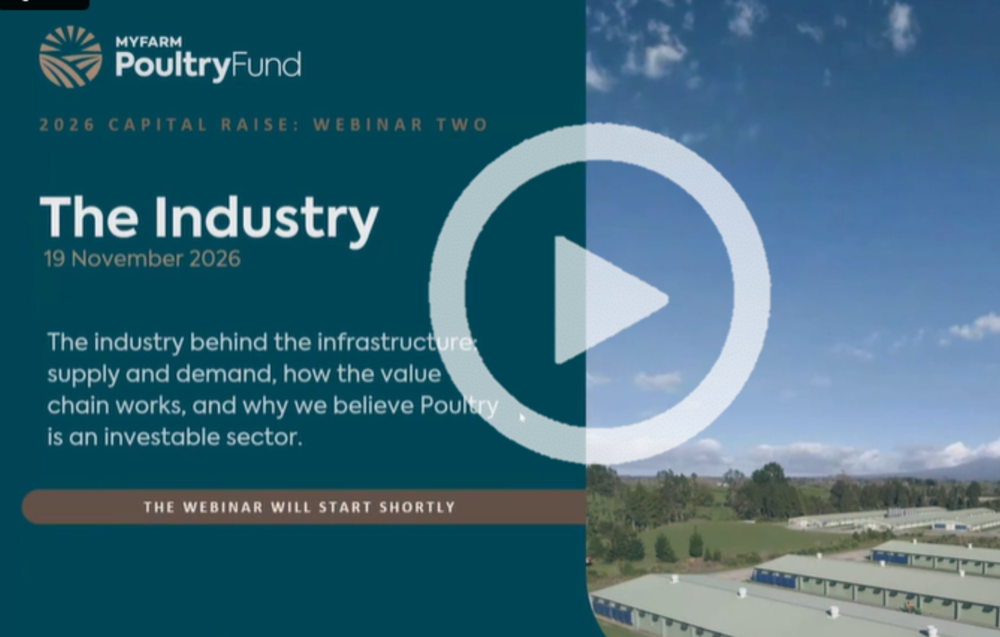
Our latest market insight examines the distinctive structure of New Zealand's poultry industry.
New Zealanders consume more chicken than any other meat. Around 230,000 tonnes were produced in 2024 from approximately 121 million birds, with almost all production consumed domestically. Behind that scale is a highly specialised industry characterised by significant infrastructure requirements, close integration between growers and processors, and strict biosecurity controls.
We recently held a long-form discussion webinar with John Hartnell, former Chair of the NZ Tegel Growers Association and current director of the MyFarm Poultry Fund, to discuss the industry's economics and operating structure. Five attributes stood out.
1. Demand is supported by efficient production economics
Chicken has become New Zealand's most-consumed meat, supported by its relative affordability, broad consumer appeal and efficient conversion of feed into meat. Unlike beef and lamb, which are produced largely for international markets, almost all New Zealand chicken production is consumed domestically.
Poultry therefore occupies a complementary position in the wider agricultural economy: it supplies an efficient and accessible source of protein to local consumers while allowing a greater share of higher-value red-meat production to be directed to export markets.
2. Growers and processors are highly interdependent
The commercial model is based on a close relationship between processor and grower. Typically, the processor owns the birds, supplies chicks and feed, and manages processing and distribution. The grower provides the specialist infrastructure and, in some cases, the labour required to raise them.
As our speaker described it, the relationship is effectively “a marriage” with each party depending on the other for the supply chain to function.
3. Adding new production capacity takes time and is capital intensive
The industry plans for continued growth in poultry demand. On the estimates discussed during the webinar, annual growth of around 4% could require approximately 20,000 to 40,000 square metres of additional shed capacity each year.
Bringing that capacity into production is not straightforward. Capital requirements, resource and building consents, infrastructure availability, and proximity to neighbouring properties can all constrain development. At the same time, some poultry sheds still operating in New Zealand were constructed around 45 years ago, highlighting the longer-term requirement for both replacement and new capacity.
4. Biosecurity materially shapes the domestic industry
New Zealand’s biosecurity settings restrict the importation of raw poultry meat, meaning domestic demand is predominantly supplied by local production. For investors, this creates a structurally protected domestic market in which future demand must largely be met through local production capacity.
Biosecurity risk remains important. During the webinar, our speaker described an outbreak of highly pathogenic avian influenza on a New Zealand poultry farm as a question of “when, not if”. Industry protocols, including the ability to move free-range birds indoors when risks increase, are intended to reduce exposure and limit the effects of an outbreak.
5. Modern poultry farming is operationally efficient
Poultry farms can operate with relatively small labour requirements compared with the scale of their productive infrastructure. A 6,000-square-metre operation, for example, may typically require around 1.5 full-time equivalent staff.
The sector has some flexibility across production systems. Our speaker noted, of every 10,000 birds grown under free-range conditions, approximately 7,000 may ultimately be sold as free-range product, with the balance sold through other channels.
What else should investors consider?
The sector is not without risk. Feed is the industry’s largest operating cost and is influenced by international commodity prices and supply-chain conditions. Gas is widely used to heat poultry sheds, creating exposure to energy costs and availability. Processing capacity is also concentrated among a small number of major operators, while historical growth in chicken consumption cannot be assumed to continue indefinitely.
Despite these considerations, the sector's strong domestic demand, biosecurity protections, established processing relationships and attractive production economics may provide a supportive long-term environment for investment in specialised poultry infrastructure.