There are a range of investment opportunities available, each with their own set of risks and returns. Over the years, we have seen high investor interest in rural commercial property investments, particularly from investors looking for regular income.
As for all investments, returns from property can fluctuate over time as interest rates, market forces and other factors interact. In this article, we will discuss this investment cycle, what we have learnt from investing in this sector, and why MyFarm sees 2026 as an opportune time to consider an investment in rural commercial property.
What we mean by “rural commercial property”
Rural commercial property sits inside the agricultural value chain: think cool stores, distribution hubs, specialist processing and storage facilities, Recognised Seasonal Employer (RSE) accommodation, farm supply outlets, laboratories and genetics facilities that enable the sector to function. As investments, these properties can typically be leased long-term to operating companies, often with regular CPI adjustments and market rent reviews, with most property outgoings passed on to the tenant. In plain English: you receive rent for the tenant’s permitted use of the premises under the lease—not for taking production or price risk.
Farmland and rural commercial properties are two types of assets, each offering distinct financial returns.
Farmland income depends on production and commodity prices; rural commercial property converts the same agri-demand into lease-backed, often inflation linked rental income. Returns on the farm often have little correlation with lease income from rural commercial assets—useful in diversifying your investments when you want stability for retirement or intergenerational planning. If you already own or operate an economic farming unit and want more certainty in your off-farm income stream, rural commercial property can help to deliver it.
Why we believe 2026 is a good time to invest
There are several reasons why we consider 2026 an opportune time to invest in rural commercial property.
Lower OCR rates mean lower debt servicing payments
Debt costs have fallen over the past 18-months and are considered by many to be near the trough (or as low as many analysts expect them to go).
Still-recovering property prices provide potential for attractive cap rates and investor returns
Property prices, whilst recovering in places, remain well below their previous highs, providing the ability for attractive cap rates (the comparison of the return you get from lease income compared to purchase price). Based on previous cycles, a period of lower interest rates could lead to further recovery of asset prices in the coming years. Indicators would suggest that the market is closer to the start of an upswing in property prices than the end, meaning now is a good time to buy.
In short, we are seeing a favourable balance of market forces for new property acquisitions in 2026: lower debt costs and still-competitive asset prices. This combination provides the opportunity for higher “carry” (rent yield minus cost of debt) and investor returns.
What we’re targeting in 2026
We’re pragmatic about liquidity, unlisted commercial property should pay a margin over “money in the bank.” With deposits sitting around the low to mid 3% range in late 2025/early 2026 and debt costs aligned to a ~2.25–2.5% OCR, we’re aiming to bring new syndicates that deliver around or over 7.5% per annum cash yields, subject to asset, tenant covenant and financing terms.
Our experience and learnings
As with any investment class, rural commercial property comes with its own set of opportunities, challenges and risks that can affect potential returns. Experience, insight and resilience are all important to help uncover the best opportunities and overcome challenges when they arise.
MyFarm has invested across the rural commercial property sector for close to a decade, with a portfolio that includes large scale poultry facilities, RSE accommodation, a modern food distribution centre, and specialist cool store assets. We work alongside nationally recognised partners including Hortus, Southern Cross Horticulture, and Tegel.
Our experience across multiple market cycles has enabled us to continually adapt to shifting conditions and enhance our strategies. Over the past decade, the investment cycle can be segmented into three distinct periods:
- Period 1 (2018 to 2022), falling interest rates lead to rising property prices. Our acquisitions early in this period benefited most from cheaper debt and firming (increasing) asset values.
- Period 2 (2023 to 2025), we saw the cycle turn: interest rates rose sharply, meaning higher debt servicing costs for new acquisitions and slimmer free cashflow. As fixed debt rolled off lower rates, servicing costs rose. Property values fell and cap rates increased. This was hard on existing owners, but better for new acquisitions. Some of our acquisitions during this period benefitted from (and continue to benefit from) investor distributions in the 9-10% p.a. range.
- Period 3 (2026 onwards), this period is currently characterised by lower debt costs and still-competitive asset prices.
Acquiring a property at a good price is only the beginning of the investment journey. Unless you are purchasing rural commercial property outright and managing it yourself, your long‑term outcomes rely heavily on your investment manager’s ability to steer the asset through changing circumstances. Over time, markets evolve, tenant needs shift, and operational issues arise—and no asset is immune from challenge. What ultimately distinguishes an investment manager is not the absence of these challenges, but the capability to navigate them— calmly, methodically, and always with investors’ interests at the forefront.
As a recent example that reflects MyFarm’s commitment to active management, following Cyclone Gabrielle and the resulting drop in local apple production, a group of cool stores became untenanted. We worked closely with the bank and investors to protect asset value, drew on our networks to secure a new long‑term tenant, and, with the support of investors, established a development plan that positions the asset for future growth.
The point is, despite detailed planning and active management, things don’t always unfold as intended and unexpected issues can arise in any asset class. What matters most is having the tenacity to identify solutions quickly and to execute them well.
View as a pdf here.
Ready to learn more?
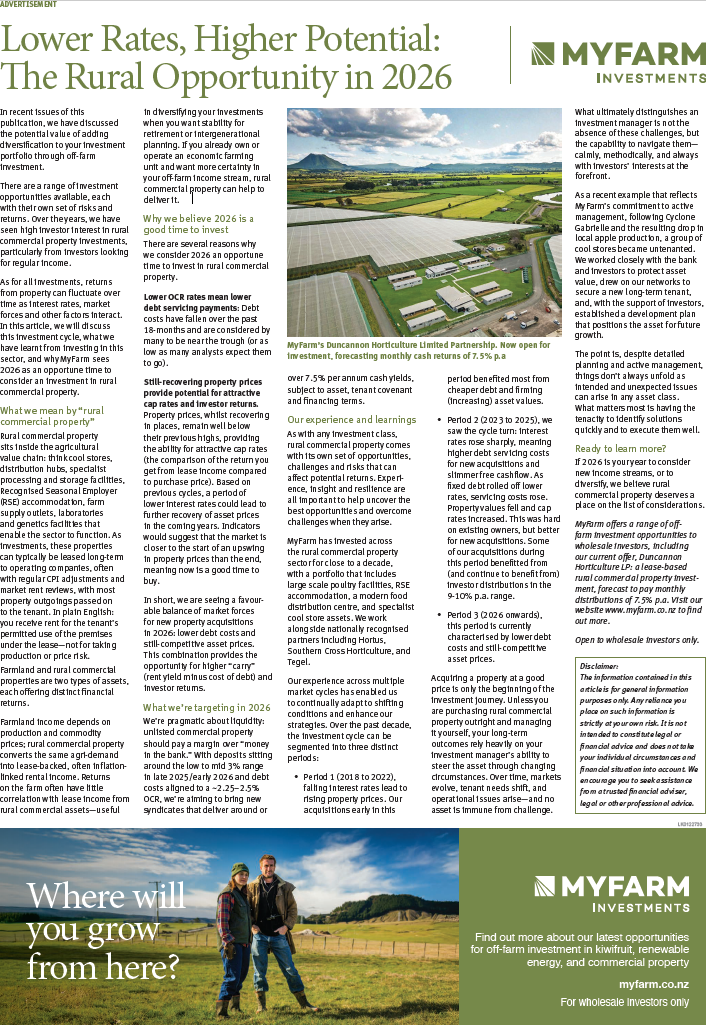
If 2026 is your year to consider new income streams, or to diversify, we believe rural commercial property deserves a place on the list of considerations. MyFarm offers a range of off-farm investment opportunities to wholesale investors, including our current offer, Duncannon Horticulture LP: a lease-based rural commercial property investment, forecast to pay monthly distributions of 7.5% p.a. Visit our website www.myfarm.co.nz to find out more.
Open to wholesale investors only.
Disclaimer:
The information contained in this article is for general information purposes only. Any reliance you place on such information is strictly at your own risk. It is not intended to constitute legal or financial advice and does not take your individual circumstances and financial situation into account. We encourage you to seek assistance from a trusted financial adviser, legal or other professional advice.