A generational shift is occurring which could see over $150 billion in rural assets change hands, making the question of how best to invest farm capital more valuable than ever. Succession, risk management, and business resilience are top-of-mind for some of New Zealand’s farming families.
As we know, farming is a cyclical business. At present, we have the benefit of a low exchange rate, reasonable commodity prices, falling interest rates and farm values which are probably trending up, all of which is good. But farming families with foresight are looking through these good times and planning for the long term.
With more than half of all farm and orchard owners to reach retirement age in the next decade, according to the Rabobank’s 2025 white paper, Changing of the Guard – Stepping up the Succession. Conversation in New Zealand Farming, it makes sense that now is the time to plan and prepare. Traditionally, many farmers have chosen to expand their businesses during good times by buying more land. This approach offers scale, operational control, and a sense of legacy. However, investment considerations are changing, some farmers are contemplating diversification through off-farm investments, allocating capital into assets outside the core farm business, such as equities or land-based investments. So, this raises the question, where to from here? The right answer will depend on your goals, risk tolerance, family circumstances, and appetite for change. Below, we compare the two approaches, drawing on sector commentary, research, and specialist practical experience.
Diversification via Off-Farm Investment
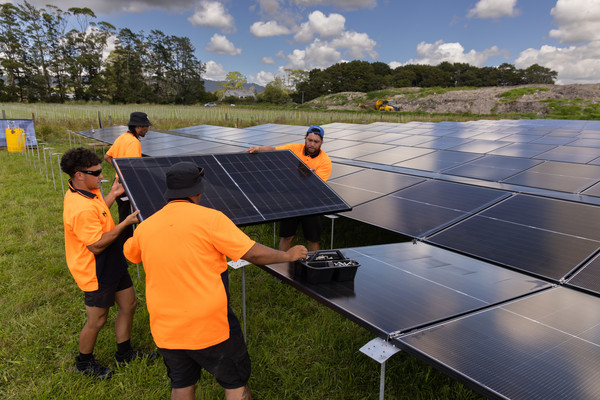
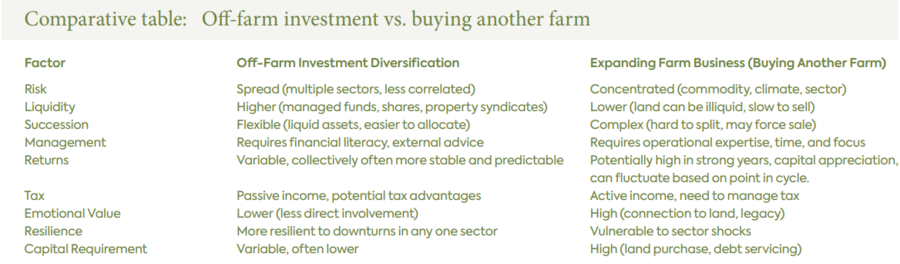
Off-farm investment diversification means allocating capital into assets beyond the farm gate. This could include kiwifruit, solar, forestry, rural commercial property (the offers that MyFarm have available), or more broadly, managed funds, or equities. The aim is to create income streams that are less correlated with farm returns, reduce exposure to commodity cycles, and provide cash and assets (and liquidity) for succession and retirement. If in the right structure, these assets can provide better liquidity than farms, making cash more accessible for emergencies or new opportunities.
Off-farm investments may also help with succession planning, allowing liquid assets to be more easily split among family members or their income used to support Mum and Dad’s retirement independently from the farm business. Certain investment structures may offer tax efficiencies which are complimentary to taxable farm income.
Investing outside the farm gives access to growth sectors like kiwifruit, renewables, and commercial property, without the need for direct management. On the flip side, investing off the farm can present several challenges. One is the loss of control, as there is less direct influence over how these investments perform compared to managing your own farm. This change requires a trust in external managers or advisers to make sound decisions on your behalf.
Another challenge is exposure to market volatility, including risks from share market downturns and fluctuations in property cycles. Off-farm investments may also yield lower returns than the potential long-term capital appreciation seen with prime farm property in strong years. There is also a degree of emotional detachment, compared to that of the family farm(s).
Expanding the Farm Business
This could be through buying another farm, with the extra land either complimenting the core operation (finishing block, runoff) or expanding it. This approach is familiar, tangible, often emotionally satisfying and does provide advantages. Larger scale can lower costs, boost bargaining strength and improve machinery and labour efficiency. Focusing on one enterprise sharpens management, simplifies decisions, and supports technology adoption. If the farming business grows large enough this can, of itself, provide for family succession. However, challenges arise when concentrating risk, as income and asset values become dependent upon the risks applying to a single commodity or sector, from market fluctuations, climate change, or disease.
Liquidity presents another issue, with land periodically being difficult to sell or divide. The complexity of succession is heightened if heirs lack either the interest or the capability to take over the family business. Capital demands may be considerable, requiring substantial initial investment as well as ongoing debt servicing. Whether you choose to expand your farm business or diversify through off-farm investments, the key is to match your strategy to your family’s needs, risk appetite, and long-term vision. As New Zealand’s farming sector faces its largest-ever intergenerational transfer of wealth, the question is not just how to grow, but how to secure the future.
View the pdf here.
Disclaimer:
The information contained in this article is for general information purposes only. Any reliance you place on such information is strictly at your own risk. It is not intended to constitute legal or financial advice and does not take your individual circumstances and financial situation into account. We encourage you to seek assistance from a trusted financial adviser, legal or other professional advice.